PVDF (polyvinylidene fluoride) film is the most sensitive piezo-electric polymer. Acoustic emission (AE) monitoring using 40ƒÊm-thick PVDF film was applied to the non-destructive detection of termite attack in wood. The frequency spectra of AEs detected by PVDF film had some peaks under 10kHz which depended on the characteristic frequencies of the longitudinal vibration of the specimen. Although the sensitivity of 1-ply PVDF sensor was lower than that of a PZT sensor, the sensitivity of a PVDF sensor could be increased by using multiple sheets. These results suggest that it is feasible to use PVDF film mounted in the wall of a house as an AE sensor to detect termite activity.
Introduction
Fujii et al.1-4) showed that acoustic emissions (AE) could be detected from a specimen under attack by termites. Their laboratory results and field tests suggest that AE monitoring may bean effective method for remotely detecting the presence and activity of termites in wood, even if the attack is still in its incipient stage. On the other hand, Lewis et al.5) and Lemaster et al.6) noted that the sensitivity of an AE sensor depends on the resonant frequency of AE sensors and concluded that more detailed studies of the optimal measuring system are needed if AE monitoring is to be used as a practical non-destructive method for detecting termites. PVDF (polyvinylidene fluoride) film is a very sensitive piezo-electric polymer, although it is less sensitive than PZT sensors. PVDF film can be easily attached to curved and irregularly shaped materials, since it is thin and quite flexible. The feasibility of PVDF as the AE sensor was discussed.
Experiment 1 : Detection of artificial AEs using PVDF film.
1-1. PVDF (polyvinylidene fluoride) Film
PVDF film is much less stiff than the ceramic piezoelectric. In addition the density is much less resulting in significantly better impedance matched to wood.
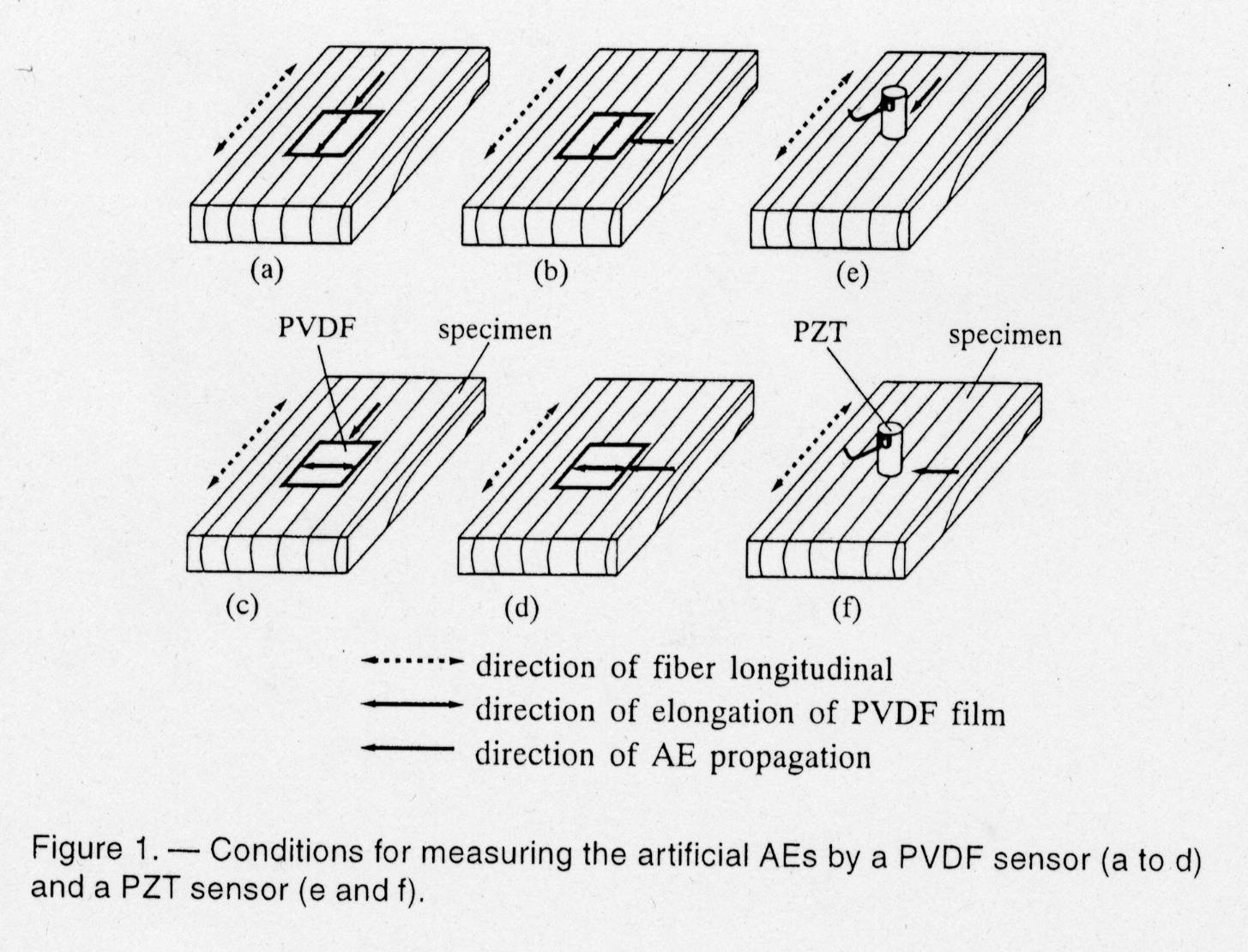
PVDF film (40ƒÊm-thick) was elongated for by polarization, the greatest piezo-electric effect appears in this direction. Both surfaces of the PVDF film were coated with aluminum under vacuum evaporation to form the terminals. A low-noise cable was attached to the terminals of the PVDF film using conducting paste, and the PVDF film was grounded to reduce noise. The signal from the film was transferred through the cable to an amplifier.
1-2. Materials and methods
Sugi (Cryptomeria. japonica D. Don) wood was cut into a specimen 570mm long with across-section of 310 by 45mm, and air-dried. PVDF squares of 15 by 15mm, 20 by 20mm, 25 by 25mm, and 40 by 40mm were attached to the side of the specimen with adhesive. A piezoelectric transducers (PZT sensors) were 40mm-height and 12mm-diameter. PZT sensors with a fundamental resonant frequency of 70 or 100kHz were also attached to the specimen using a rubber band. Silicone grease was used as an acoustic coupler. To investigate the ability of the PVDF film to detect AEs in wood, the signal generated by breaking a pencil lead by pushing it on the specimen surface was used as an artificial AE source. A pencil lead of 0.5mm in diameter was broken into 3mm lengths. An artificial AE wave was generated 150mm from the center of the sensor(Fig. 1). The generated AEs propagated longitudinally or radially. Signals from both sensors were amplified by 40dB and discriminated at a threshold voltage of 0.2V. Neither highpass nor lowpass filters were used. The frequency spectra were analyzed with a FFT analyzer.
1-3. Results and discussion
Figure 2 shows examples of the waveform and frequency spectrum of AEs detected by a PVDF sensor and a PZT sensor, after being amplified and discriminated. In both frequency spectra, a few peaks were observed under 10kHz, corresponding to the resonant frequencies of the longitudinal vibration of the specimen. Some peaks near 70kHz, corresponding to the resonant frequency of the PZT sensor, are observed in the spectrum for the PZT sensor. However, in the frequency spectrum for the PVDF sensor, no discrete peak is observed over 10kHz, since the PVDF sensor has a lower Q-value (sharpness of resonance).
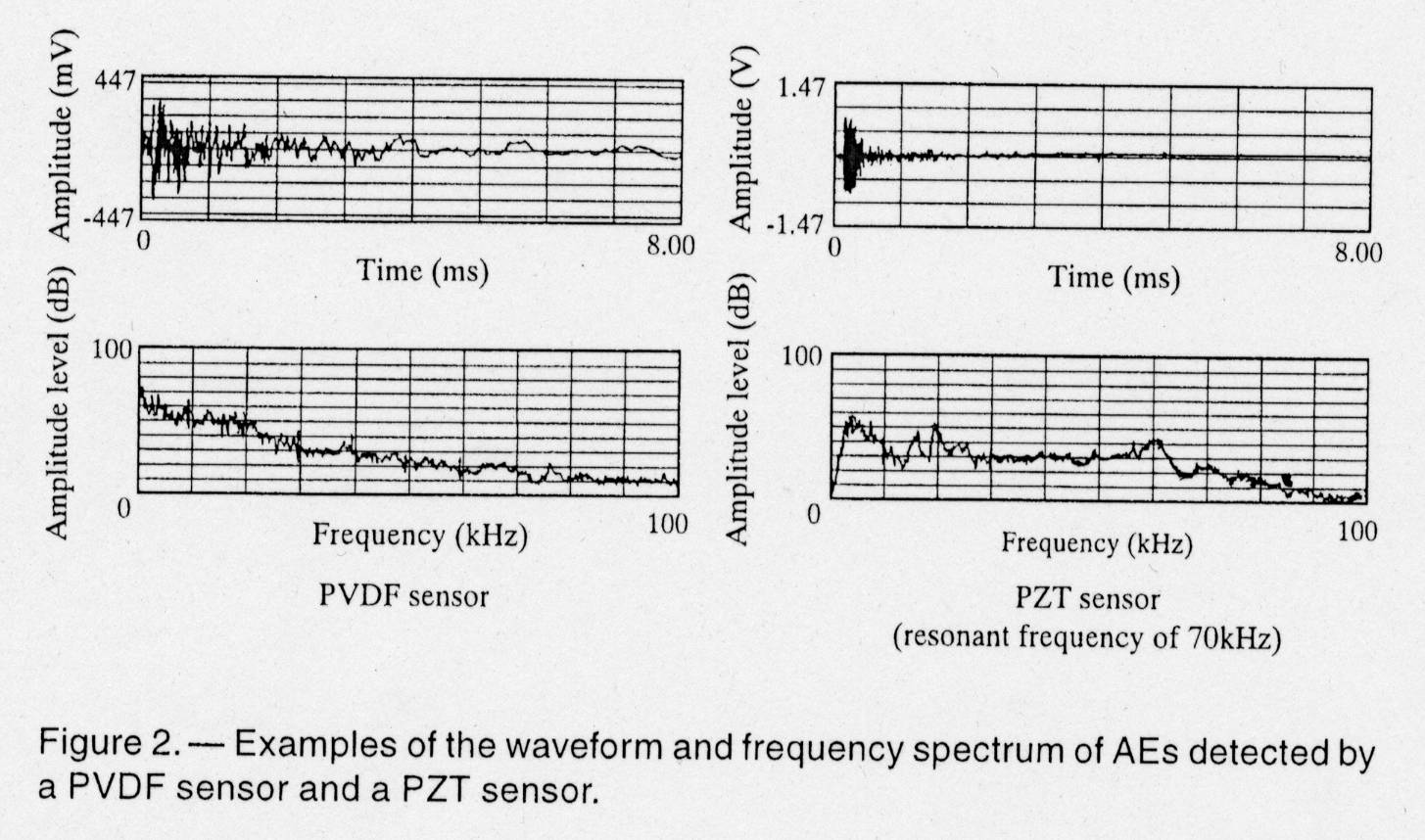
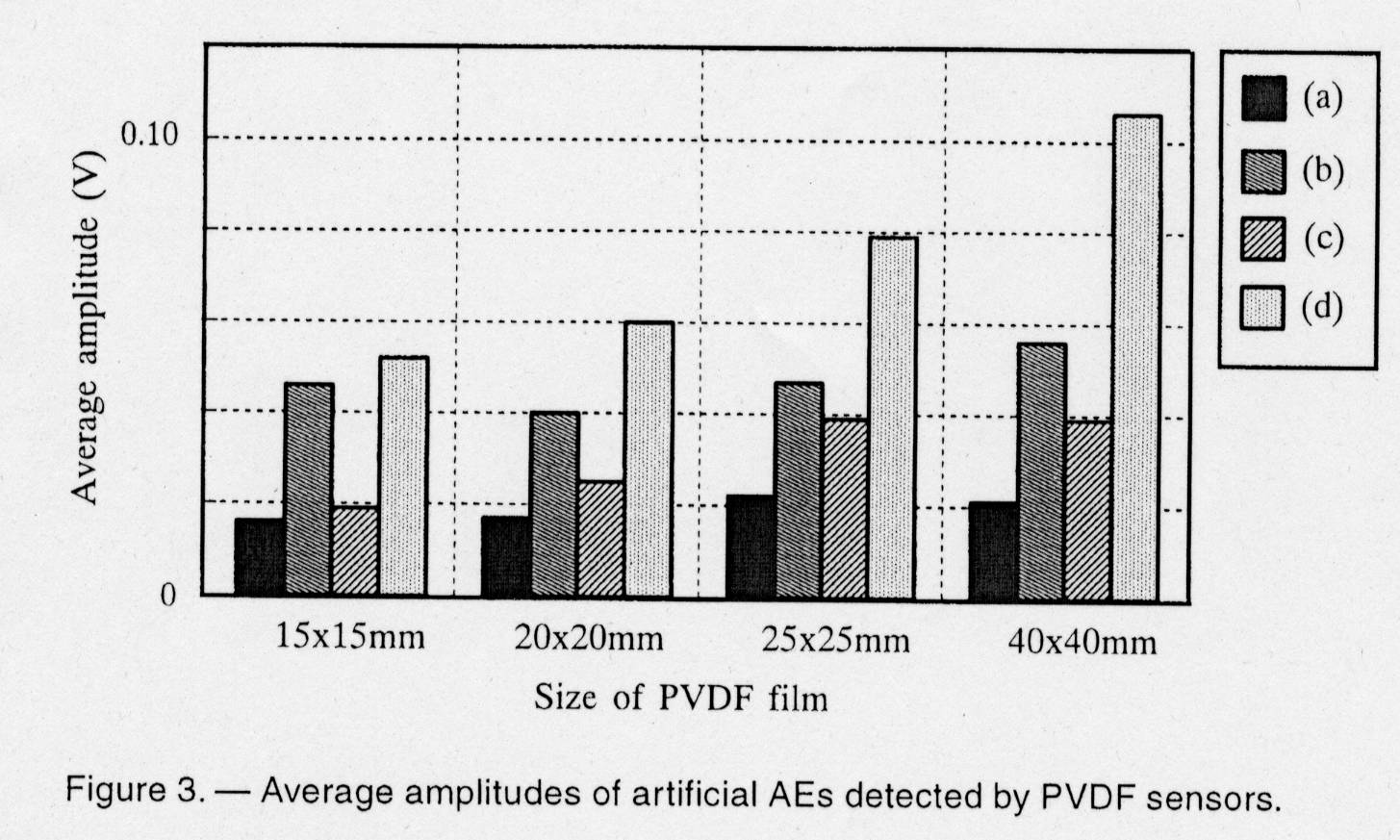
Figure 3 shows the average amplitudes of ten AE signals(breaking the pencil leads) detected by PVDF films of different sizes and estimated from the overall level of the frequency spectrum. The amplitude of the AEs that propagated radially was greater than that propagated longitudinally. However the amplitude in the longitudinal direction was larger than that in the radial direction, when it is estimated by the peak to peak values of the detected signals. A larger PVDF film was associated with a larger AE amplitude. Figure 4 shows the average amplitudes of AE signals detected by a PVDF sensor in comparison with those detected by a PZT sensor. As with PVDF sensors, the amplitude of AEs that propagated radially was greater than that propagated longitudinally, as was discussed for Figure 3.
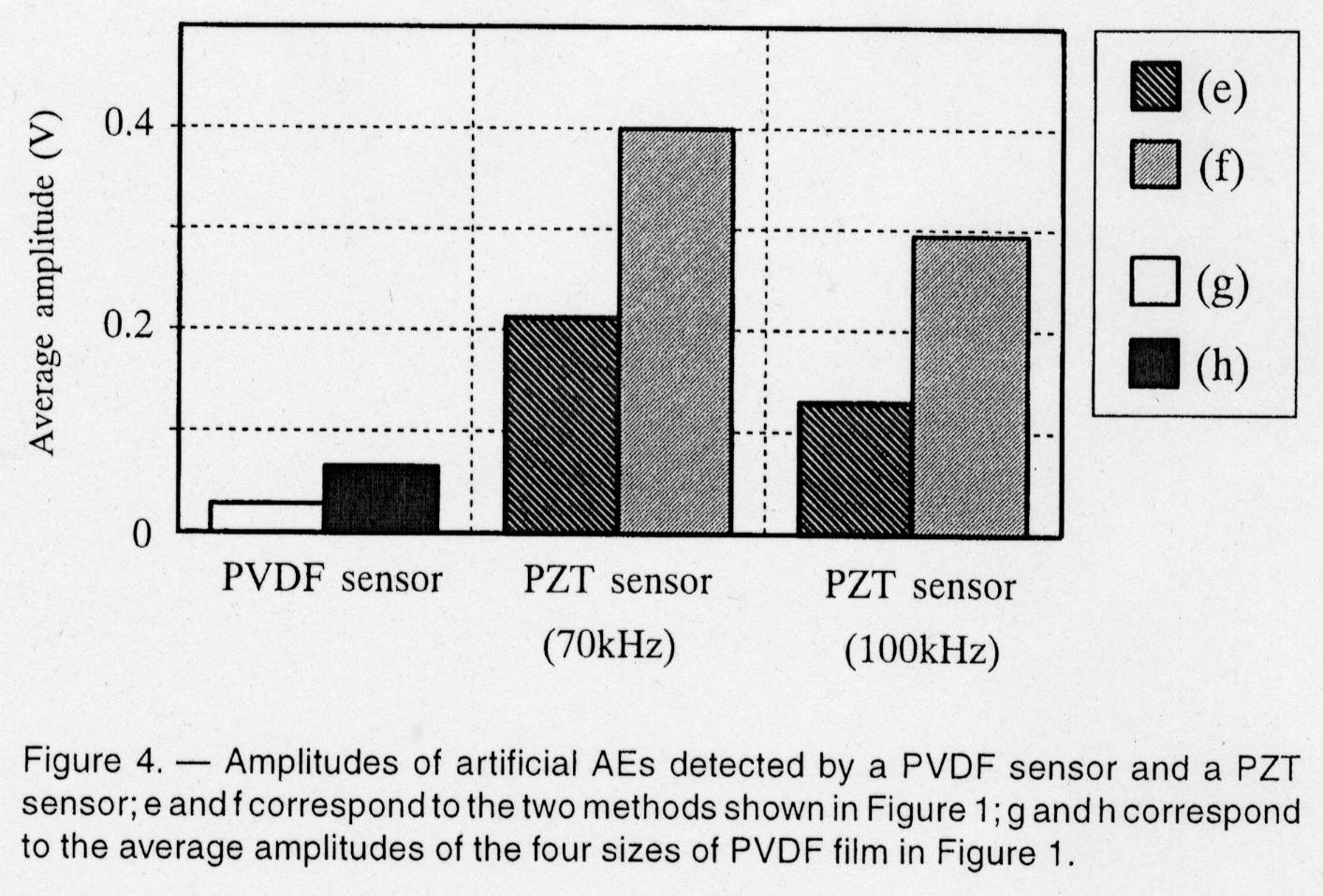
Considering the results with the different sizes of the PVDF film and the PZT sensors, the AE amplitudes for the PVDF sensors were from about one-tenth to one-twentieth as large as those for the PZT sensors. To increase the sensitivity of the PVDF sensor, a sensor consisting of three layers of PVDF film was used. The AE amplitude for the 3-plies PVDF sensor was about twice that for a 1-ply PVDF sensor. It was difficult to detect AEs using PVDF sensors of more than three layers because the background noise level increased and, consequently, the signal/noise ratio (S/N ratio) decreased.
Experiment 2 : Detection of AEs generated by termite attack using PVDF sensor.
2-1. Materials and methods
Western hemlock (Tsuga heterophylla Sarg.) wood was cut into a small specimen 30mm long(longitudinal) with a cross-section of 30 by 30mm. A hole was drilled 10mm in diameter and 15mm deep, and the sample was allowed to air dry. A group of 100 worker termites(Copotermes formosanus Shiraki) was put into the hole, which was then sealed with a silicone plug. PVDF sensors (1-ply and 3-plies; 25 by 25mm) and a PZT sensor with a resonant frequency of 70kHz were attached to the surface of the specimen with adhesive and silicone grease, respectively. Signals from the PVDF sensors were amplified 80dB and discriminated at a threshold voltage of 0.2V, while the respective values for the PZT sensor were 70dB and 0.12V. In this study, the PVDF sensor had 10dB higher gain than a PZT sensor and different thresholds since the PVDF sensor would detect AEs on the better condition. Another specimen of western hemlock (600mm long; cross-section 55 by 45mm, with a hole of 10mm in diameter drilled 30mm deep) was also prepared and allowed to air dry. A group of 100 worker termites (C. formosanus Shiraki) was placed into the hole. A PZT sensor was also attached to the nearest position to the hole as a reference sensor. The PVDF sensor and a PZT sensor with a resonant frequency of 70kHz were moved at 100-mm increments from the reference sensor.
2-2. Results and discussion
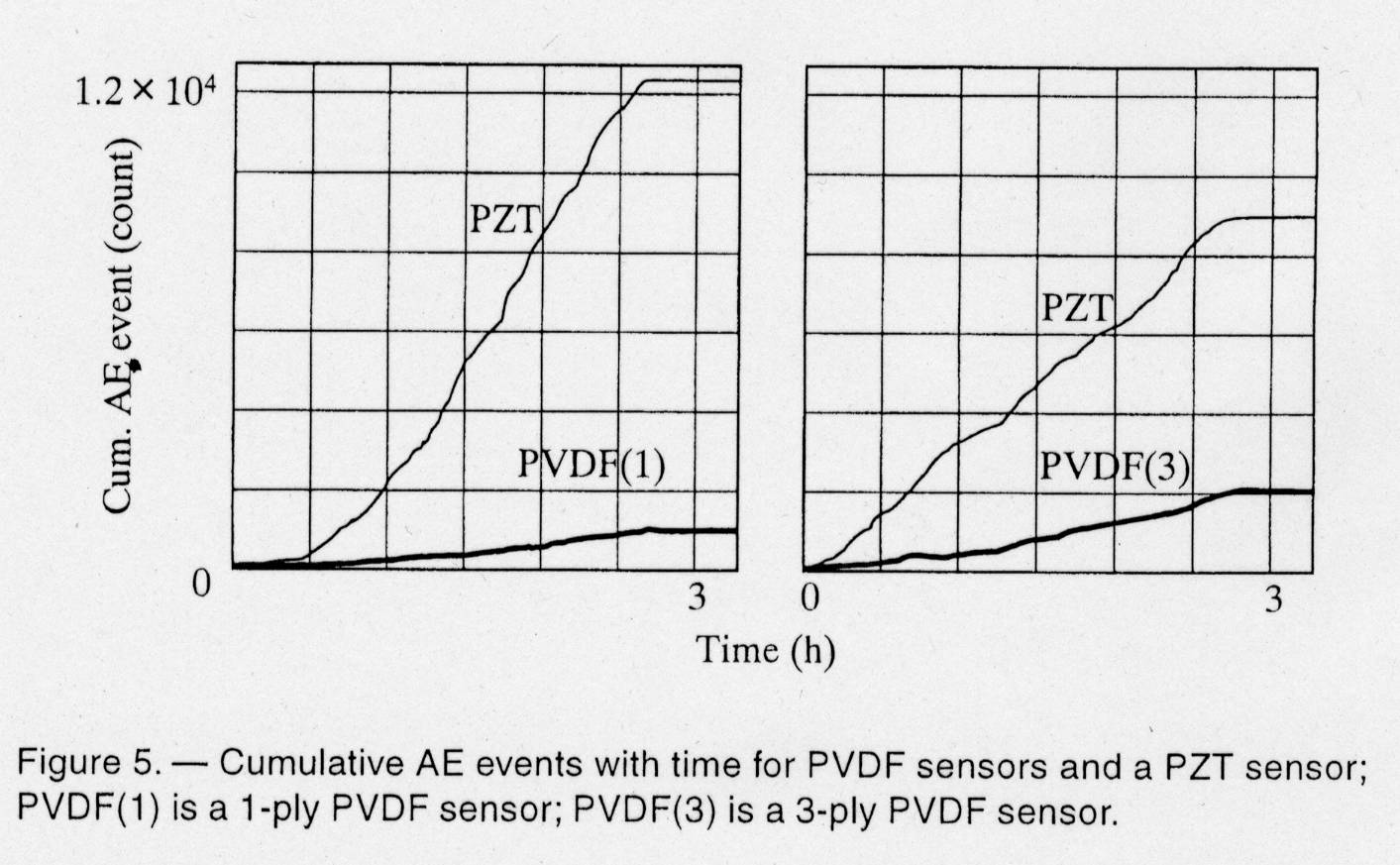
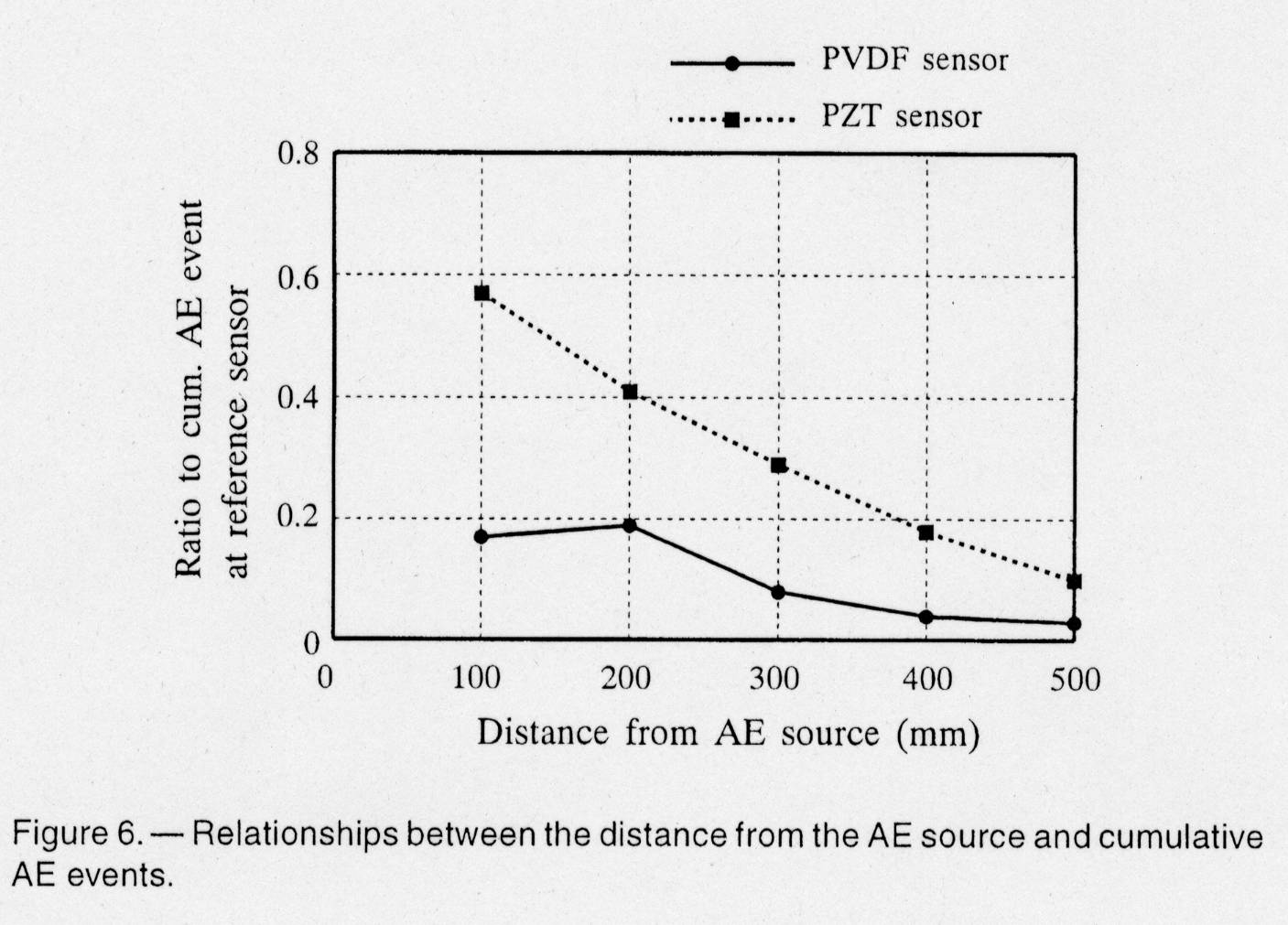
Figure 5 shows the cumulative events of AEs generated by termite feeding and detected by the PVDF sensors (1-ply and 3-plies) and the PZT sensor. The cumulative AE events detected by the 1-ply PVDF sensor were about one-twelfth as large as those detected by the PZT sensor, while the cumulative AE events detected by the 3-plies PVDF sensor were about one-fifth as large as those detected by the PZT sensor. Figure 6 shows the decrease in the cumulative AE events with the distance from the AE source. The cumulative AE events decreased with the distance from the AE source due to attenuation of the AE wave in the wood. Note that the rate of the decrease with the PVDF sensors is smaller than that with the PZT sensor. The cumulative AE events detected by a PVDF sensor may be greater than those detected by a PZT sensor, as the distance from the AE source increases. PVDF sensor may be more profitable than PZT sensor to get a wider monitoring area for the AEs generated by termite feeding in wood.
Closing remarks
To establish the usefulness of PVDF film for detecting termite attack in wood, it is necessary to confirm the present results by carrying out AE detection with PVDF film for other experimental conditions like structural members of wooden houses, and to study further on PVDF sensors to get more sensitivity and availability as the AE sensor for wooden constructions.
References
1) Y. Fujii, M. Noguchi, Y. Imamura and M. Tokoro: Detection of termite attack in wood using acoustic emissions, Int. Res. Group of Wood Preserv., Document No. IRG/WP/No. 2331 (1989)
2) Y. Fujii, M. Noguchi, Y. Imamura and M. Tokoro: Using acoustic emission monitoring to detect termite activity in wood, Forest Products J. 40 (1), 34-36 (1990)
3) Y. Fujii, M. Owada, M. Noguchi, Y. Imamura and M. Tokoro: Detection of termite attack in wood using acoustic emissions, Int. Res. Group of Wood Preserv., Document No. IRG/WP/No. 2355 (1990)
4) Y. Imamura, M. Tokoro, M. Owada, Y. Fujii, and M. Noguchi: Detection of feeding behavior of termites using AE monitoring, Int. Res. Group of Wood Preserv., Document No. IRG/WP/No. 1514 (1991)
5) V. R. Lewis, R. L. Lemaster, F. C. Beall and D. L. Wood: Using AE monitoring for detecting economically important species of termites in California, Int. Res. Group of Wood Preserv., Document No. IRG/WP/No. 2375 (1991)
6) R. L. Lemaster, F. C. Beall, V. R. Lewis : Detection of Termites with Acoustic Emission Forest Prod. J. 47(2), 75-79 (1997)